🏎 Why I Treated My Weekend Go-Karting Like a Data Engineering Project
Don’t wait for experience. Create it.
Issue #8 of The Corporate Layer — January 2026
They say that in racing, you either have “the pace” or you don’t. But in the age of Data Science, speed isn’t just a talent, it’s a calculated output.
This weekend, somewhere between the smell of gasoline and the roar of the engines, I didn’t just go to the karting track to drive. I went to build.
I didn’t rely on “gut feeling” or a flimsy paper receipt; instead, I pulled telemetry out of a weekend hobby to uncover the seconds I was leaving on the asphalt.
Here is the story of how I fired the driver (me) to hire a Race Engineer (also me), and built the Garcelán Racing Team.
Here’s how!
🏁 10 Years on the Track, 1 Weekend in the Cloud
I have been karting for over 10 years.
From the moment I was tall enough to reach the pedals, I’ve been chasing that specific feeling you get when you step onto the track. The smell of gasoline, the vibration of the engine, the adrenaline of the first corner.
For 30 minutes, you feel like Fernando Alonso.
But for the last decade, the ritual has always ended the same way. You pull into the pit lane, take off your helmet, and walk to the counter.
Back in the day, they used to hand you a flimsy thermal receipt. (I still keep a few fading ones in a drawer somewhere).
Lap 4: 57.5s
Lap 5: 56.7s
Nowadays, it’s a bit more modern. Most tracks have apps that show you the classification: 1st, 2nd, 3rd. But here is the problem:
Knowing I was “3rd” doesn’t help me become “1st”.
These apps are just digital receipts. They tell me the result, but they don’t tell me the process.
Did I brake too early on Turn 3?
Did I lose traction on the hairpin?
Was I fast because of skill, or because I had a lighter kart?
Most people look at the time, say “nice,” and go home. But as I stared at those basic numbers, my “Data Engineer brain” started itching.
I realized I was generating valuable data every millisecond, but it was evaporating. I realized that if I wanted to improve, I couldn’t just be a driver. I needed to be a Race Engineer.
So, I did what I do best: I over-engineered a solution.
🛑 The “Black Box” of Karting
In professional racing, decisions are made on data. In Formula 1, there are hundreds of sensors sending real-time telemetry to a wall of engineers. In amateur karting, decisions are made on “vibes.”
“I felt fast that lap.”
“I think I braked late.”
The "8-year-old driver" in me was happy just to drive. But the Data Engineer in me was furious. As an AI Researcher and Data Scientist, "I think" is not a valid metric. I wanted observability.
I have my own helmet and gear, but I was missing the digital layer. I needed to bridge the gap between "driving" and "analyzing."
I decided to build a Full-Stack Telemetry Pipeline. So,
I fired the driver (me) and hired a Race Engineer (also me).
🎨 Over-Engineering a Hobby (The Corporate Layer Way)
Before writing a single line of code for the telemetry app, I had to solve the most important part: The Identity.
If I was going to treat this like an F1 operation, I needed a team name. I couldn’t just call the project “Jorge’s Kart App.” That sounds like a homework assignment.
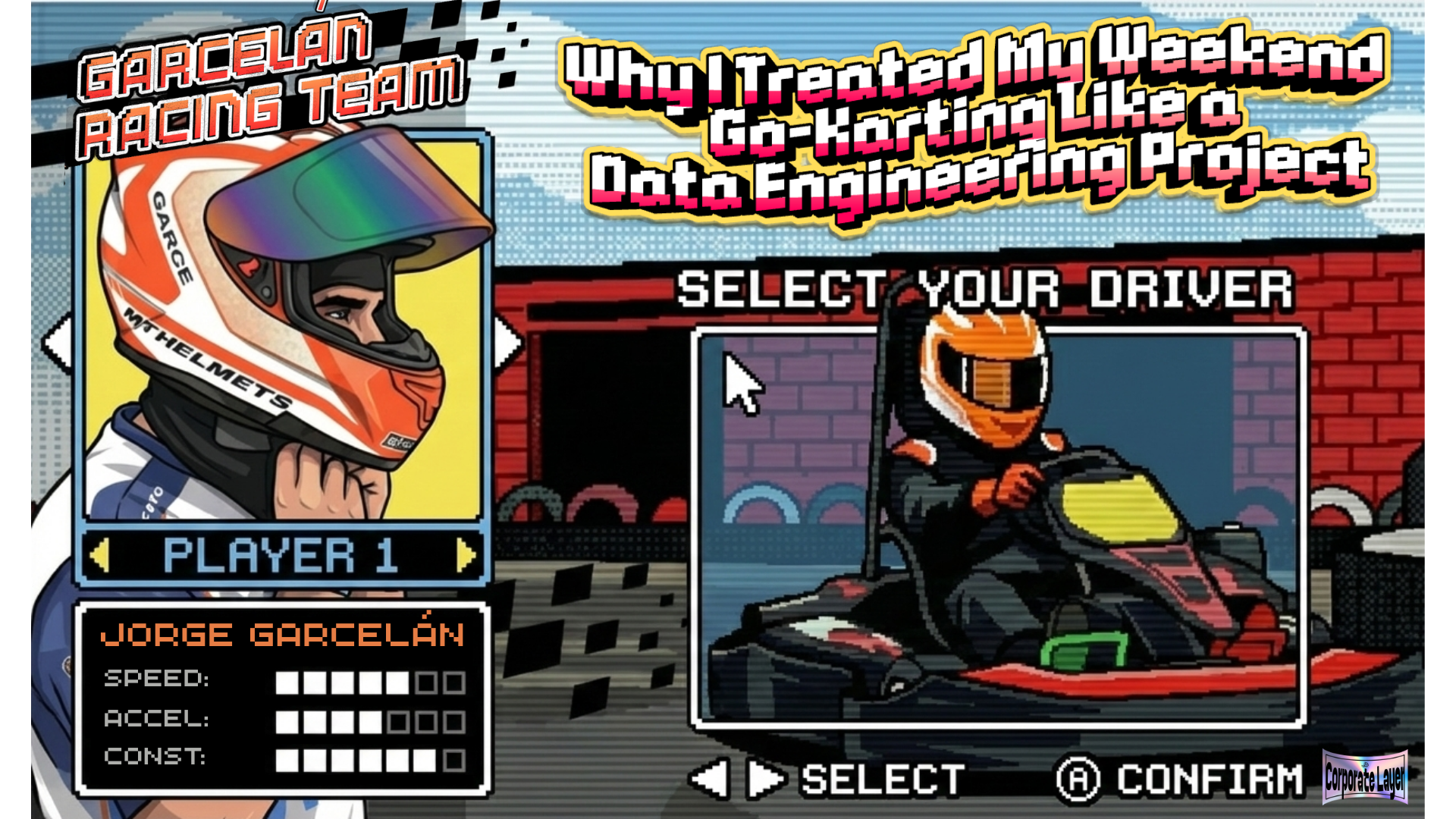
Introducing: Garcelán Racing Team.

I designed this logo to capture the two worlds I live in:
The Nostalgia: The pixel art style represents the arcade games of my childhood (like Mario Kart!).
The Reality: The helmet is a digitization of my actual helmet that I wear on the track.
By giving the project a name and a logo, I stopped treating it like “some code I’m writing” and started treating it like a Product for my racing team.
🛠️ The Architecture: From Asphalt to Cloud
I decided to build a Full-Stack Telemetry Pipeline. I used RaceChrono to capture the raw data, but I needed a custom “Mission Control” to actually make sense of it.
Here is the architecture driving the Garcelán Racing Team:
Tier 1: Data Ingestion (The Sensors) 📡
The Tool: I use RaceChrono to capture high-frequency GPS and accelerometer data during the session.
The Challenge: RaceChrono is great for recording, but the analysis is stuck on a small phone screen. I needed to extract that raw CSV/JSON data and ingest it into my own system.
Tier 2: The Backend (The Engine) ⚙️
Processing: Python scripts to clean the noise and calculate sector deltas.
Logic: I wrote algorithms to calculate my “Theoretical Best Lap” (combining my best sectors from different laps).
Tier 3: The Frontend (The Dashboard) 📊
The UX: A custom Web App.
Heatmaps: Visualizing braking zones (Red) vs. Acceleration zones (Green) overlaid on the track map.
The “Why”: So I can look at a chart and say, “Ah, I’m losing 0.2 seconds because I’m not carrying enough exit speed on the chicane,” instead of just guessing
✨ Why This Matters
Why go through all this effort for a weekend hobby?
Because Applied AI isn’t just about optimizing business revenue or automating emails. It’s about optimizing life.
When you apply professional skills to personal passions, two things happen:
You learn faster. I am learning more about real-time data visualization building this kart app than I ever would doing a generic tutorial.
You build a story. “I like go-karts” is a hobby. “I built a custom telemetry web-app to analyze my racing line” is a Portfolio Piece.
The Garcelán Racing Team might only have one driver and one engineer (both me), but digitally, it operates like a constructor.
📩 The Final Act: Why Subscribe?
This newsletter is home to #TheCorporateLayer.
The motto is simple: Don’t wait for experience. Create it.
We are often told that we need years of tenure to be effective, creative, or “senior.” But as I showed at the dinner table, the right tools, combined with curiosity, can act as a time machine. They allow us to bridge the gap between “student” and “professional” faster than ever before.
In 2026, I am documenting that exact transition. From the final code blocks of my Master’s Thesis (TFM) at UC3M to navigating the real professional world.
Join me if you want to explore:
The Tech: Practical AI use cases (beyond just memes).
The Journey: Real-time updates on breaking into the industry.
The Mindset: How to leverage technology to punch above your weight class.
If you are ready to build the layer, hit subscribe.
#CorporateLayer
Building experience before you have it.